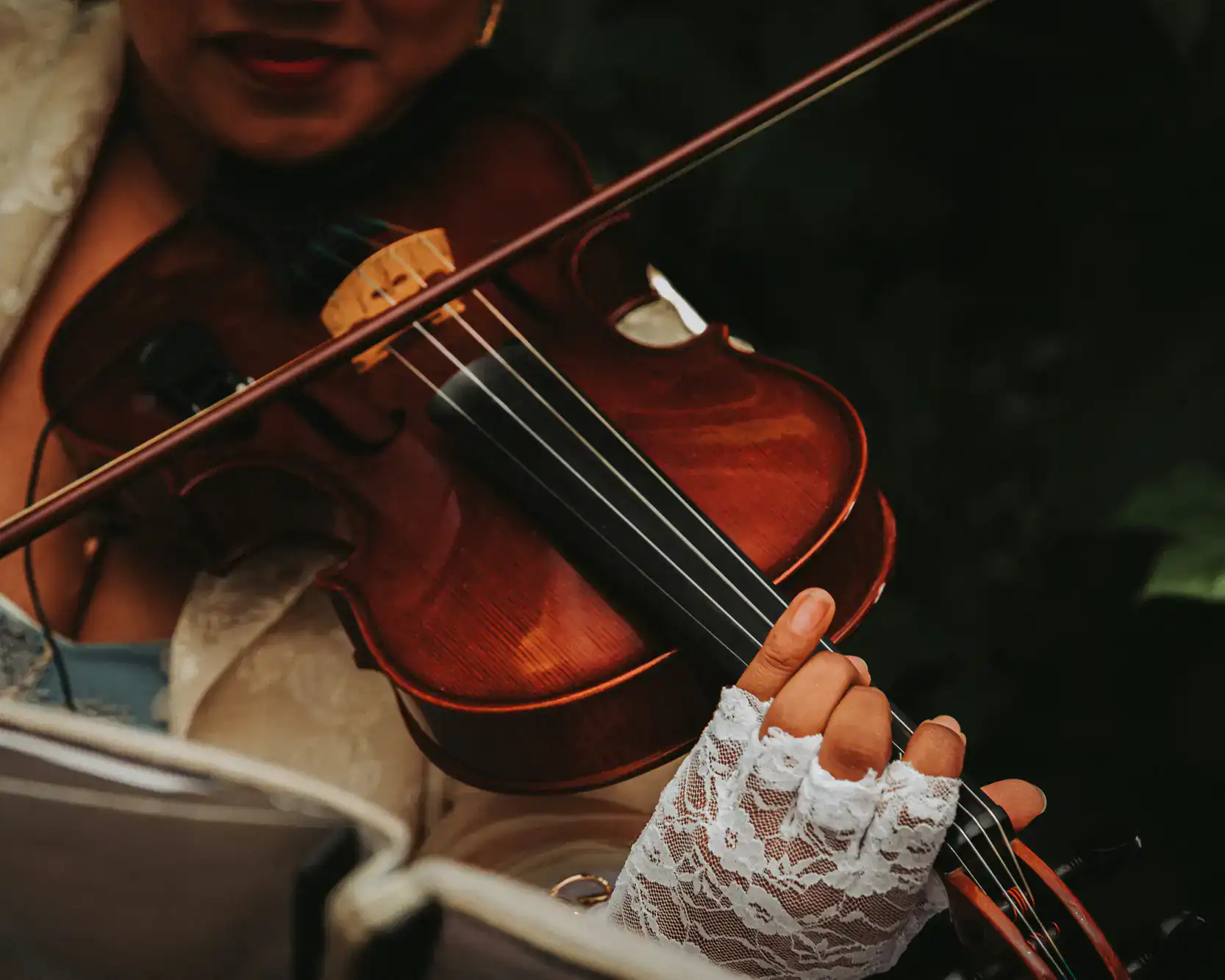
Most couples never consider a solo violist, and that is exactly what makes it such a memorable choice for your ceremony.
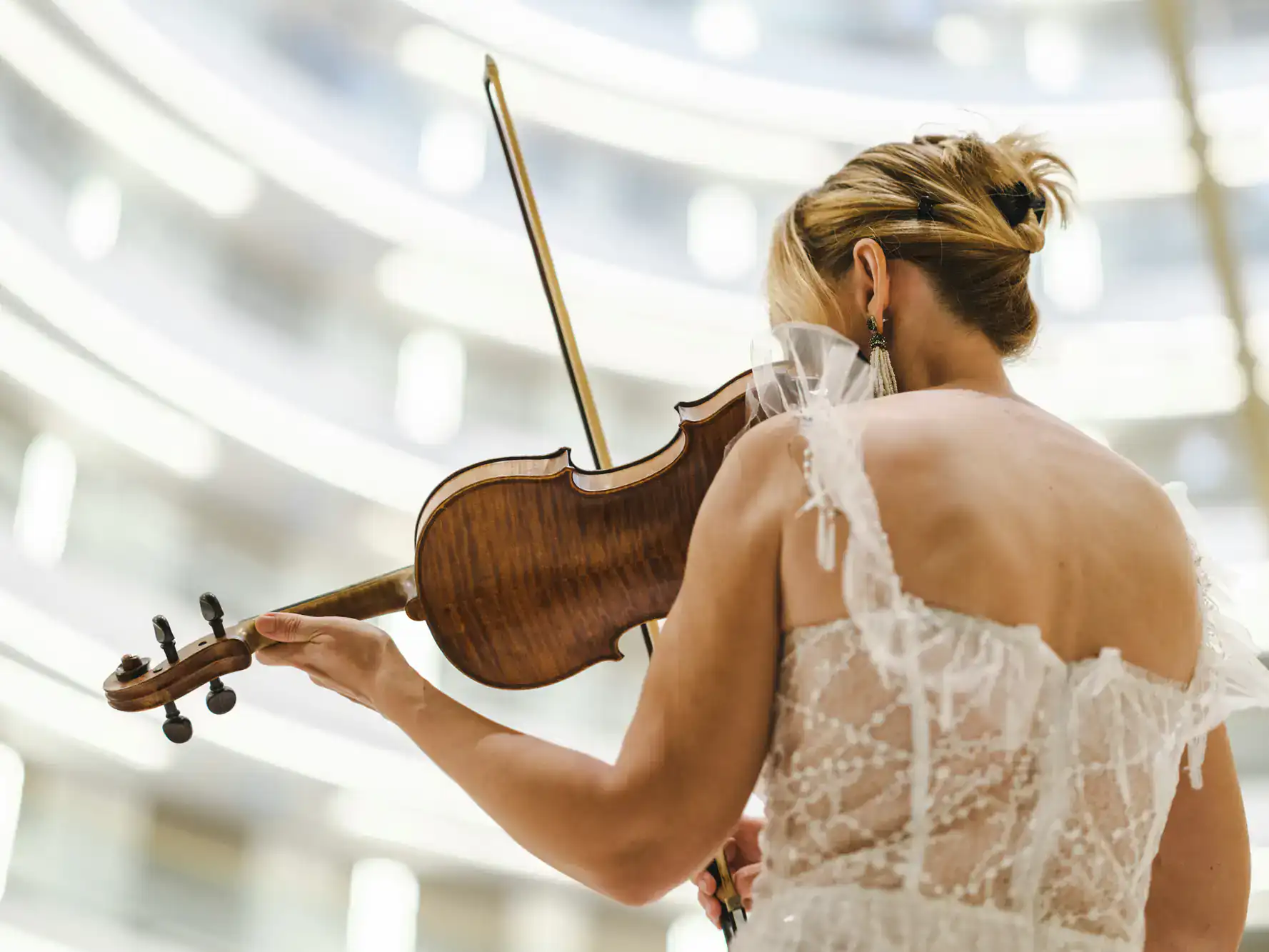
Most couples spend months thinking about the reception: the DJ, the dance floor, and the energy of the night. Ceremony music gets figured out later. A playlist, perhaps, or a string quartet if the budget allows. But there is an option most couples never think to ask about, and the ones who discover it tend to feel like they have found something genuinely rare.
A solo wedding violist. Not a violinist, but a violist. The difference matters more than you would expect, and if you are planning a wedding in Wisconsin or Minnesota, it is worth understanding before you finalize your ceremony entertainment.
The viola is closely related to the violin, but it is a distinct instrument with a completely different voice. It is larger, and it plays in a lower register, what musicians call the alto or tenor range. Where a violin’s sound tends to be bright and piercing, the viola is warmer, deeper, and more velvety. Some people describe it as the difference between a spotlight and candlelight. At a wedding ceremony, that tonal difference creates a noticeably different atmosphere. The viola does not announce itself; it envelops. It fills the room, the lakefront, or the barn with a sound that feels intimate rather than grand, which makes it particularly well-suited to the quiet, emotional weight of a ceremony.
Most guests have never heard a solo violist at a wedding. That is part of what makes the choice so memorable.
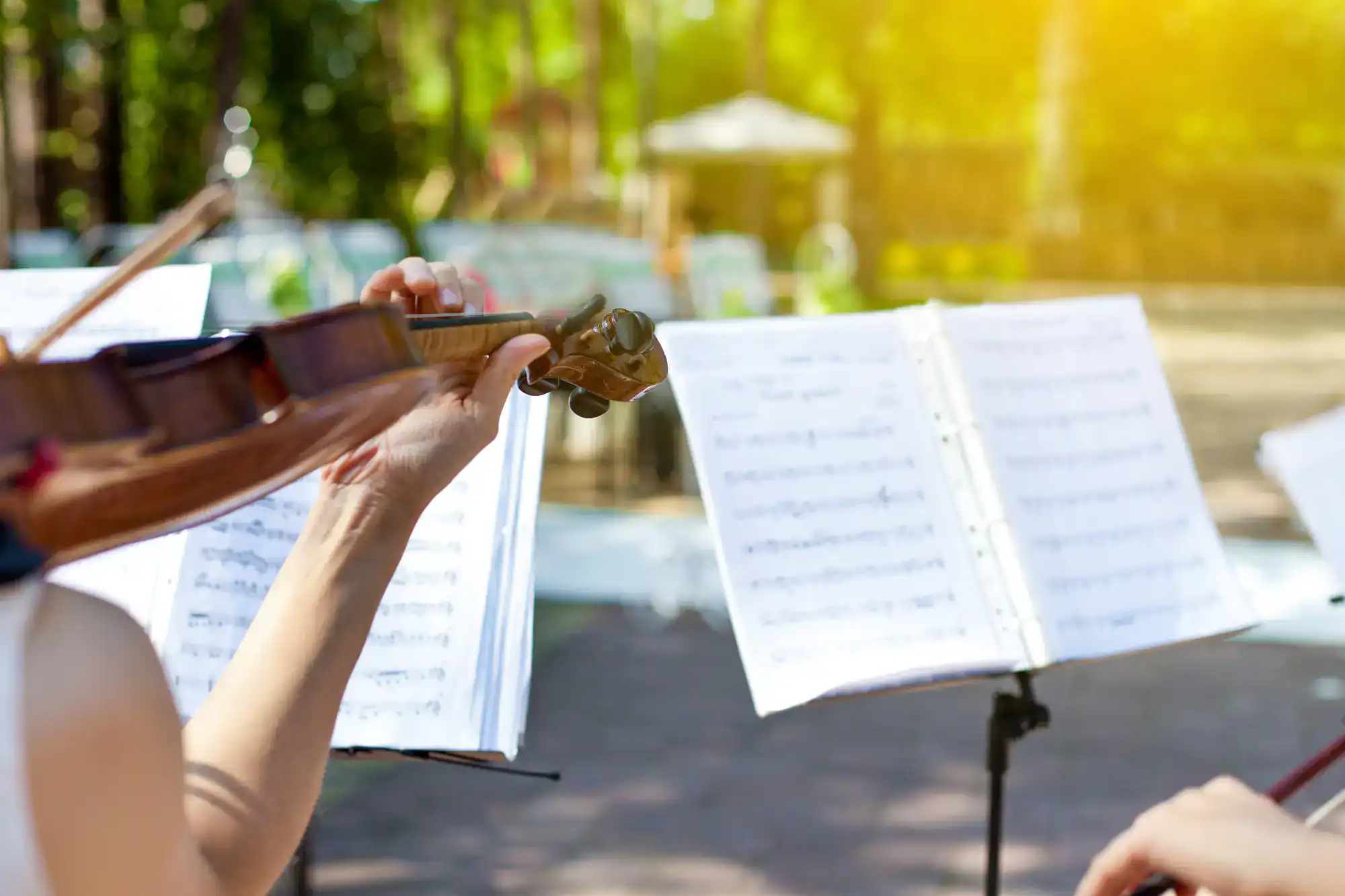
Think about the moments that define a ceremony: guests settling into their seats, the wedding party making their entrance, and the first glimpse of the couple. These are quiet, emotionally charged moments. The music underneath them isn’t background noise; it is the emotional scaffolding holding everything together.
The viola’s warmth is particularly effective in these moments because it does not compete with the emotion; it amplifies it. Research consistently shows that live music creates up to 70% stronger emotional responses than recorded tracks. The specific tonal character of the viola adds something a violin or a speaker-played track simply cannot replicate: a sound that feels human, present, and unhurried.
This matters especially in Wisconsin and Minnesota’s most popular ceremony settings. If you are getting married at a lakefront venue along Lake Mendota or Lake Monona in Madison, at one of Dane County’s beloved barn venues, or in a garden setting across the Twin Cities metro, the acoustic environment is naturally forgiving and open. A live violist’s sound carries beautifully in those spaces, the kind of carrying that a Bluetooth speaker pretending to be a string instrument simply cannot do.
There is also something worth saying about the rarity of the choice. Most wedding guests have sat through dozens of ceremonies with the same pre-recorded string arrangements playing from a speaker near the aisle. A live violist playing as guests are seated is immediately noticeable, not in a distracting way, but in a way that signals this couple thought carefully about every detail of their day. That intentionality is something guests remember and talk about.
Eight out of ten couples, according to industry research, specifically remember the exact music and timing of their processional long after the wedding day. If that is true, and the data suggests it is, then the music playing as you walk toward your future spouse is one of the highest-return investments you can make in your ceremony experience.
This is one of the most common concerns couples raise, and it is a fair one. There is a perception that string instruments, and the viola in particular, belong exclusively to classical repertoire. Canon in D, Ave Maria, Jesu Joy of Man’s Desiring. Beautiful pieces, but not necessarily what every couple has in mind.
The reality is that a skilled violist can arrange and perform a wide range of music. Contemporary pop songs, film scores, and modern love songs; the viola is a versatile instrument that adapts well across genres. If you want something from Ed Sheeran or a piece from a film score that is meaningful to you as a couple, that conversation is worth having with your musician before you assume it is off the table.
What matters most is giving enough lead time for any custom arrangements. Professional musicians working the Wisconsin and Minnesota wedding market are accustomed to these requests, and the ones worth booking will tell you honestly what they can and cannot deliver. One thing that surprises couples: the viola’s lower, warmer tone actually suits certain contemporary songs better than a violin would. Pieces that lean on emotional depth rather than brightness, like slower ballads, introspective love songs, and pieces with a lot of harmonic richness, tend to translate beautifully to the viola’s natural voice.
It is also worth thinking through the full arc of your ceremony music, not just the processional. Prelude music as guests are seated, the wedding party entrance, the bridal processional, any music during the ceremony itself (a unity ceremony, for example), and the recessional; a skilled violist can carry all of it, adapting tempo and feel to match each moment. That flexibility is something a pre-recorded playlist simply cannot offer, especially when, as happens in one out of four ceremonies, a timing delay throws the original plan off.
Want live answers?
Connect with a Eternally Ours Entertainment expert for fast, friendly support.
Booking a live musician for your ceremony raises a practical question most vendors do not address directly: how does this work on the day? Who cues the musician? What happens if the processional runs long? What if the flower girl freezes at the top of the aisle for thirty seconds (it happens more than you would think)?
These are legitimate logistics questions, and the answer matters as much as the music itself. A live musician who is not coordinated into your ceremony timeline is a beautiful but unpredictable element. A live musician who knows your timeline, your officiant’s cue words, and your processional order before they arrive is something entirely different.
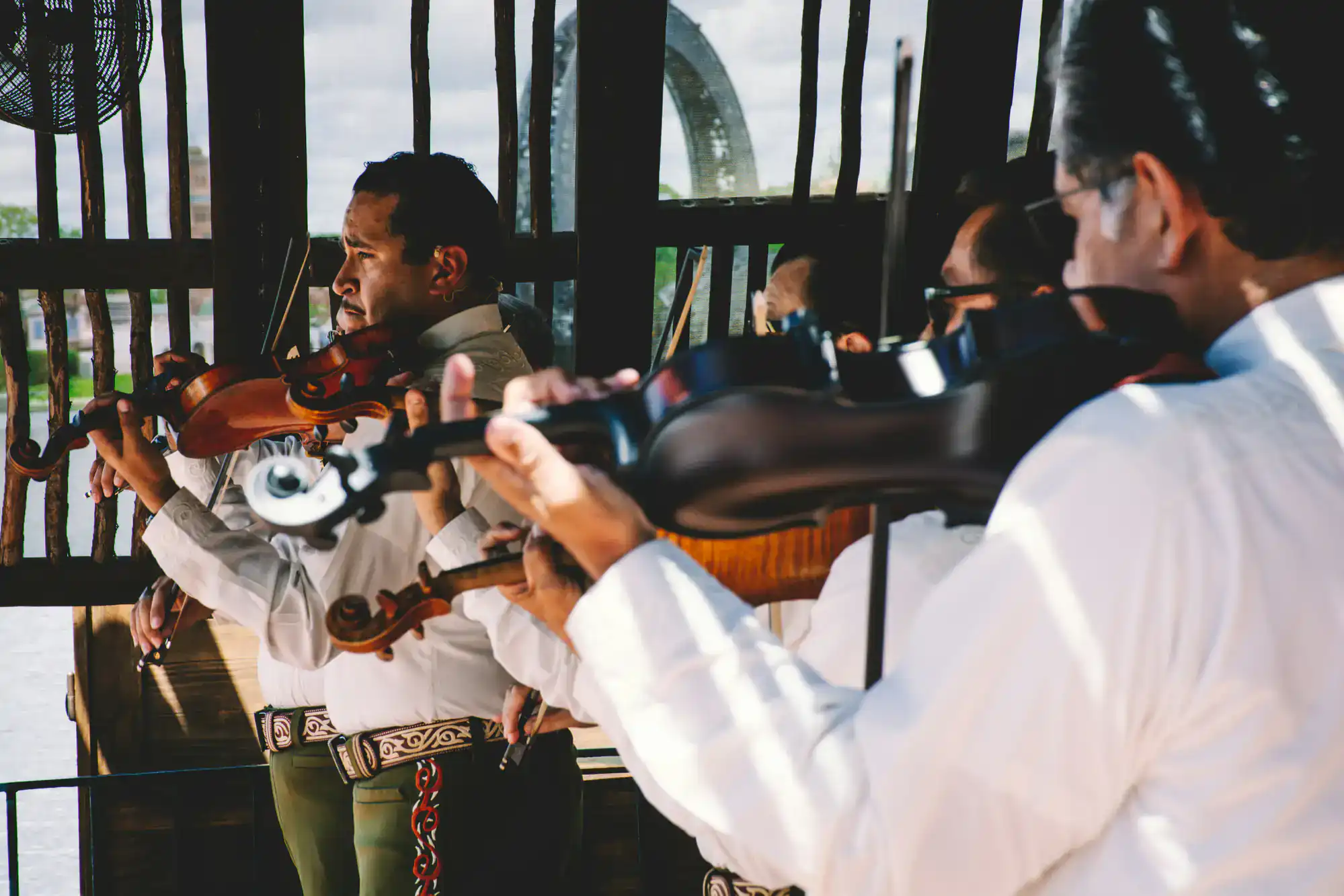
This is where live music has a genuine functional advantage over recorded tracks that rarely gets discussed. A pre-recorded processional plays at a fixed tempo for a fixed duration. If your maid of honor takes an extra thirty seconds to walk the aisle, the song does not wait. You either get an awkward silence, a jarring restart, or someone frantically hitting pause on a phone.
A live violist can loop a verse, extend an intro, or execute a natural fade the moment you reach the altar. They are reading the room in real time, responding to what is happening rather than what was planned. That adaptability is a feature, not a risk, and it is one of the strongest practical arguments for live ceremony music that most couples do not discover until after they have already made their decision.
The coordination piece is something we take seriously at Eternally Ours Entertainment. We are a company founded by professional musicians, a trumpet player and a drummer who built this brand around the belief that music is more than sound. When we bring a violist into your ceremony, they are not a separate vendor you are managing alongside everything else. They are part of a coordinated entertainment plan. Our online client portal lets you share your timeline, your music choices, and your event details in one organized space. Before your wedding day, we check in with your photographer, videographer, and venue so everyone is on the same page.
That kind of pre-event coordination is particularly valuable in Wisconsin and Minnesota, where outdoor ceremonies, like barn venues in Dane County, lakefront settings in Madison, and garden venues across the Twin Cities, can introduce weather-related timing variability that no one fully plans for. A musician who has been briefed, who knows the plan and the contingencies, is a very different asset than one showing up with a case and a song list.
It’s a fair comparison to make, and the honest answer is that it depends on what you are trying to create. A string quartet, four musicians playing together, produces a fuller, richer sound and creates a more formal, grand atmosphere. For large ceremonies in expansive venues, or for couples who want the music itself to be a major visual and sonic statement, a quartet can be the right call.
A solo violist creates something different: intimacy. The sound is warmer and more personal. There is a vulnerability to a single musician performing live that a full ensemble does not quite replicate. For couples who want their ceremony to feel genuine and unhurried rather than produced, a solo violist often lands closer to that feeling.
There is also a practical consideration. A string quartet represents a significantly larger investment than a solo musician. A professional string quartet typically costs around $2,500 to $4,500 or more. A solo violist gives you the warmth and presence of live string music at a much more accessible price point, which can free up budget for other elements of your day.
At Eternally Ours Entertainment, our Premium package pairs a full DJ with live music for both your ceremony and cocktail hour, which means the violist is not a standalone add-on you are sourcing separately, but part of a complete entertainment experience that carries from the prelude through the last dance. For couples who want live ceremony music without the complexity of managing multiple vendors, that kind of integration makes a real difference.
The Twin Cities’ deep arts culture, including the Minnesota Orchestra, the St. Paul Chamber Orchestra, and the Minnesota Opera, means Minneapolis and St. Paul couples tend to be musically sophisticated. They notice the difference between instruments. They appreciate the intentionality of choosing a viola over a violin, or a solo musician over a quartet. That same sensibility shows up in Madison’s UW community and across Dane County, where couples consistently lean toward choices that feel considered rather than conventional.
The ceremony is the one moment in your wedding that cannot be extended or replayed. Everyone in the room is watching and feeling at the same time. The music underneath that moment deserves the same careful thought you are giving everything else.
A solo wedding violist is a genuinely rare choice: warm, intimate, and immediately noticeable in the best possible way. It is the kind of detail your guests will mention on the way to the reception and remember years later.
If you are planning a wedding in Wisconsin or Minnesota and want ceremony music that is coordinated, intentional, and genuinely beautiful, we would love to talk through what that looks like for your day. Reach out to Eternally Ours Entertainment and let’s figure out the right fit together.
Summary:

Article details:
Share: