Live music or a DJ? It's one of the most debated wedding decisions. Here's a clear-eyed breakdown to help you choose — or realize you don't have to.
You’ve probably already Googled this three times. Maybe you’ve asked your recently married friends, scrolled through Pinterest boards, and still can’t land on an answer. That’s because the live music vs DJ for wedding debate doesn’t have a clean, universal winner — it depends on your venue, your guest list, your budget, and honestly, how much the music matters to you.
What most guides won’t tell you is that there’s a third path. One that doesn’t force you to choose. If you’re planning a wedding in Minnesota or Wisconsin, here’s what you actually need to know before you make this call.
On the surface, the difference seems obvious — one is a person playing an instrument, the other is someone playing recorded music. But at a wedding, the distinction goes deeper than that.
Live music creates a specific kind of atmosphere. There’s something about watching a musician perform in real time that feels elevated, intimate, and personal. It’s why so many couples want a string quartet for their ceremony or a jazz trio during cocktail hour — it signals that this event was thoughtfully designed, not just assembled.
A DJ brings something different: range, adaptability, and energy. A great DJ can move from a slow first dance to a packed dance floor without missing a beat, pivot when the room needs it, and play virtually anything your guests want to hear. That versatility is hard to replicate with a live band, which is part of why roughly 72% of couples still choose a DJ for their reception.
Budget is usually where this conversation gets real. The national average for a wedding DJ in 2025 sits around $1,689, though that number climbed 13% in 2024 alone. A full live wedding band, on the other hand, averages closer to $4,500 nationally — and that can climb to $10,000 or more for a larger ensemble or a band with a strong regional reputation.
In Minnesota and Wisconsin, DJ pricing tends to run slightly more moderate than the national average, typically in the $1,500 range for a standard package. Premium, full-service entertainment — the kind that includes professional lighting, MC hosting, multi-system audio for multi-location venues, and real pre-event planning — starts higher, and for good reason.
The cost gap between a DJ and a live band isn’t just the performance fee. A band of six musicians often comes with meal requirements, travel accommodations, setup time, and built-in breaks where the music stops entirely. Those details add up quickly and rarely appear in the initial quote.
One option that more couples are landing on — and one we see working really well for weddings across both Minnesota and Wisconsin — is the hybrid approach. Bringing in a solo musician or small ensemble for the ceremony and cocktail hour, then transitioning to a DJ for the reception. Done right, you get the elegance of live music during the quieter, more intimate moments, and the energy of a DJ when the dance floor opens. This kind of approach can reduce total entertainment costs by up to 25% compared to booking a full live band for the entire event.
The honest answer is that your entertainment budget should reflect what the experience is worth to you and your guests — not just what’s cheapest. Most planners suggest keeping entertainment somewhere between 5% and 8% of your total wedding budget, and being cautious about letting it exceed 20%, since that starts to squeeze other priorities.
The honest version of this conversation doesn’t have a clear winner. Both options have real strengths and real limitations, and the right choice depends heavily on your specific situation.
Live music is visually compelling and emotionally resonant in a way that recorded music simply isn’t. Watching a musician perform creates a shared experience — guests notice it, comment on it, and remember it. For couples who want their reception to feel like a genuine celebration rather than a party with background music, live performance delivers something intangible that a DJ can’t fully replicate.
The tradeoffs are real, though. Live bands have a fixed repertoire. If your guest list spans multiple generations — grandparents who love Sinatra, college friends who want hip-hop, cousins who won’t leave the dance floor without some early 2000s throwbacks — a band may struggle to serve all of them equally. Bands also take breaks, typically 15 to 20 minutes every hour, and without a plan to fill that silence, the energy in the room can stall.
A DJ’s greatest strength is flexibility. A skilled DJ can read the room, adjust in real time, and move between genres and decades without breaking the flow of the night. They can honor last-minute requests, respond to crowd energy, and keep the timeline moving as the MC. For multi-generational guest lists — which are extremely common at Twin Cities and Madison weddings — that range is genuinely valuable.
The risk with a DJ is that not all DJs are equally skilled at reading a room. A DJ who plays a pre-programmed playlist regardless of how guests are responding is a real and common disappointment. The difference between a professional and a part-timer often isn’t audible in a demo — it shows up at 9pm when the dance floor is either full or empty.
What matters most is finding someone who can do both: adapt musically and manage the room as a host. That combination — skilled DJ plus strong MC — is what actually makes a reception feel seamless.
Want live answers?
Connect with a Eternally Ours Entertainment expert for fast, friendly support.
The wedding entertainment market in Minnesota and Wisconsin is competitive, and the range in quality is wide. There are full-time professionals who’ve performed at hundreds of weddings, and there are part-time operators who do a handful of events a year. The price difference between them isn’t always obvious. The experience difference on your wedding night absolutely is.
Knowing what to look for before you book is the best protection against a disappointing outcome. A few things matter more than most couples realize going in.
Before you commit to any entertainment vendor, there are questions worth asking directly — not because you’re being difficult, but because the answers reveal a lot about how seriously they take the job.
Start with the basics: How many weddings have you personally performed at? Will you be the one at my wedding, or could you send someone else? Do you carry backup equipment — a second laptop, backup speakers, extra cables? Are you fully insured? Many venues in Minnesota and Wisconsin require proof of entertainment vendor insurance before allowing setup, and a surprising number of smaller operators aren’t covered.
Ask to see video from real weddings, not just a highlight reel. Watch how the DJ interacts with guests as an MC — how they handle introductions, how they manage the space between toasts and dancing, whether they talk too much or not enough. The MC function is often more important than the music selection itself, and it’s the part most couples don’t think to evaluate until they’re watching someone else’s wedding video.
Ask about their planning process. Do they offer pre-event consultations? Is there a client portal where you can share your timeline, music preferences, and vendor contact information in one place? Or is it all happening over scattered email threads? The organizational infrastructure a vendor offers tells you a lot about how prepared they’ll be on the day.
For outdoor and barn venue weddings — which are extremely popular across Minnesota and Wisconsin, from the Stillwater area and the lake communities west of the Twin Cities to the barn venues outside Madison near Verona and Mount Horeb — ask specifically about outdoor sound setup, generator access, and weather contingency planning. A professional who’s performed at these venues before will have clear, specific answers. Someone who hasn’t will give you a vague response.
Finally, ask about their music library and how they handle requests. A professional DJ has a properly licensed, professionally sourced music library that covers multiple genres and decades. More importantly, they know how to work a request into the flow of the night gracefully — not just drop it in wherever it falls.
Yes — and for a lot of couples, it’s actually the smartest approach. The “live music vs DJ” framing assumes you have to pick one, but the reality is that most weddings have distinct phases, and each phase has different entertainment needs.
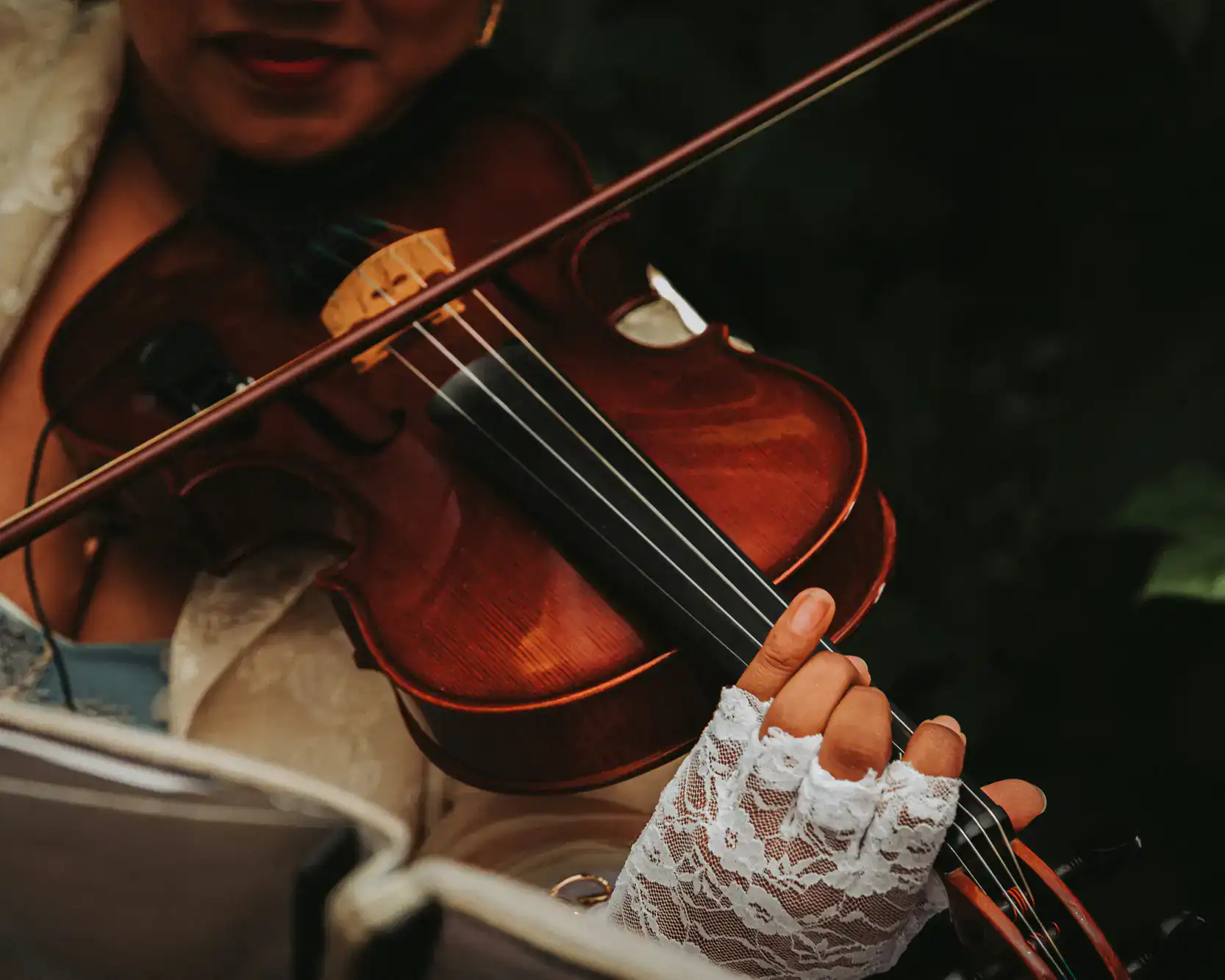
A ceremony calls for something that feels intentional and emotionally resonant — a violinist as guests are seated, a cellist during the processional, or a vocalist performing something meaningful to the two of you. That’s where live music earns its place. Cocktail hour is similar — a jazz duo or a solo guitarist playing in the background while guests mingle creates an atmosphere that a DJ playlist, however well-curated, doesn’t quite match.
The reception is where a DJ’s strengths shine. The ability to move between genres, read the room, respond to requests, and keep the energy moving for three or four hours straight is genuinely hard to replicate with a live band — especially one that needs breaks.
We see this hybrid approach work beautifully at weddings across Minnesota and Wisconsin. A lakefront ceremony on Lake Mendota with a solo violinist, cocktail hour on the terrace with a saxophone player, then a DJ who takes the night from dinner through last dance. Or a barn wedding outside the Twin Cities where acoustic guitar sets the tone during the ceremony and the DJ takes over as the sun goes down and the dance floor fills up.
The key is having a single entertainment provider who can coordinate all of it — not a live band booked through one agency and a DJ booked separately, hoping they communicate. When everything runs through one team, the transitions are seamless, the timeline stays intact, and you’re not playing middleman between two vendors on your wedding day.
That’s exactly the kind of experience we build at Eternally Ours Entertainment. Our Legacy and Eternal packages are designed around this hybrid model — combining live musicians for the ceremony and cocktail hour hour with full DJ and MC coverage for the reception, all under one roof and one point of contact. And if you’ve ever seen a DJ pull out a trumpet mid-set and improvise live over the music he’s mixing, you already know that the line between “live music” and “DJ” doesn’t have to be as firm as people think.
Most couples walk into this decision thinking it’s a budget question. It’s really a vision question. What do you want your guests to feel? What do you want to remember? The budget matters, but it’s a constraint to work within — not the starting point.
If you’re planning a wedding in Minnesota or Wisconsin, the good news is you don’t have to settle for one thing or the other. The hybrid model is real, it works, and it’s more accessible than most people realize. The bad news is that quality entertainment books fast — especially for peak-season Saturdays between May and October, when the window is short and the best vendors fill up 12 to 18 months out.
If you’re still figuring out what the right combination looks like for your specific venue, guest list, and vision, we’re here to help. At Eternally Ours Entertainment, we start with a conversation about what matters most to you. The goal is a night your guests are still talking about the next day — and that starts with a decision made carefully, not just quickly.
Summary:

Article details:
Share: